Agentic commerce is not just a new channel or a feature to add to your ecommerce platform. It is an intelligent layer that sits between buyer intent and your business data.
Think of it like explaining to someone why they should recommend your product to a friend. You are no longer speaking directly to your buyer. An intelligent “middle-man” (ChatGPT, Google AI overview e.g.) interprets, filters, and presents what it believes is most relevant.
The consumer is still the end audience. What changes is that retailers now need to think about two audiences at the same time. The human who wants the product, and the AI agent that decides what gets shown.
These two audiences behave very differently. They have different needs, different ways of understanding information, and different decision logic. For retailers, this shift creates both risk and opportunity.
It will challenge how most retailers have been driving digital business for years, but it also opens up one of the biggest growth opportunities since the early days of ecommerce.
AI doesn’t buy candy at checkout
Retail today still relies on a familiar model. Get people in, excite them, and increase the average order value. Much of this depends on impulse buying.
These are the upsells, cross-sells, and promotional offers we as consumers are being presented with during our purchase.
AI agents work differently. They are driven by intent. They do not get distracted by banners, they do not browse for inspiration, and they do not add last-minute items at checkout.
This is especially challenging for multi-brand retailers. AI agents do not care about your brand. They focus on the product, the price, and availability. If you sell the same products as your competitors, the agent will simply choose the best option.
If you’re selling white t-shirts, why would an Agent prefer you over your competitor?
Without a clear value proposition, you quickly become interchangeable.
Retailers using agentic commerce as way to capture growth
At the same time, retailers who treat agentic commerce as a priority are already seeing results.
Walmart is a strong example. Its AI assistant Sparky is now used by around half of all app users. Customers who use it have a significantly higher average order value.
As Walmart US CEO David Guggina explained, the shift is moving from traditional search to intent-driven commerce, improving discovery and conversion.
Walmart is not treating this as a new traffic acquisition channel.
It’s clear that it’s becoming a core part of how they sell.
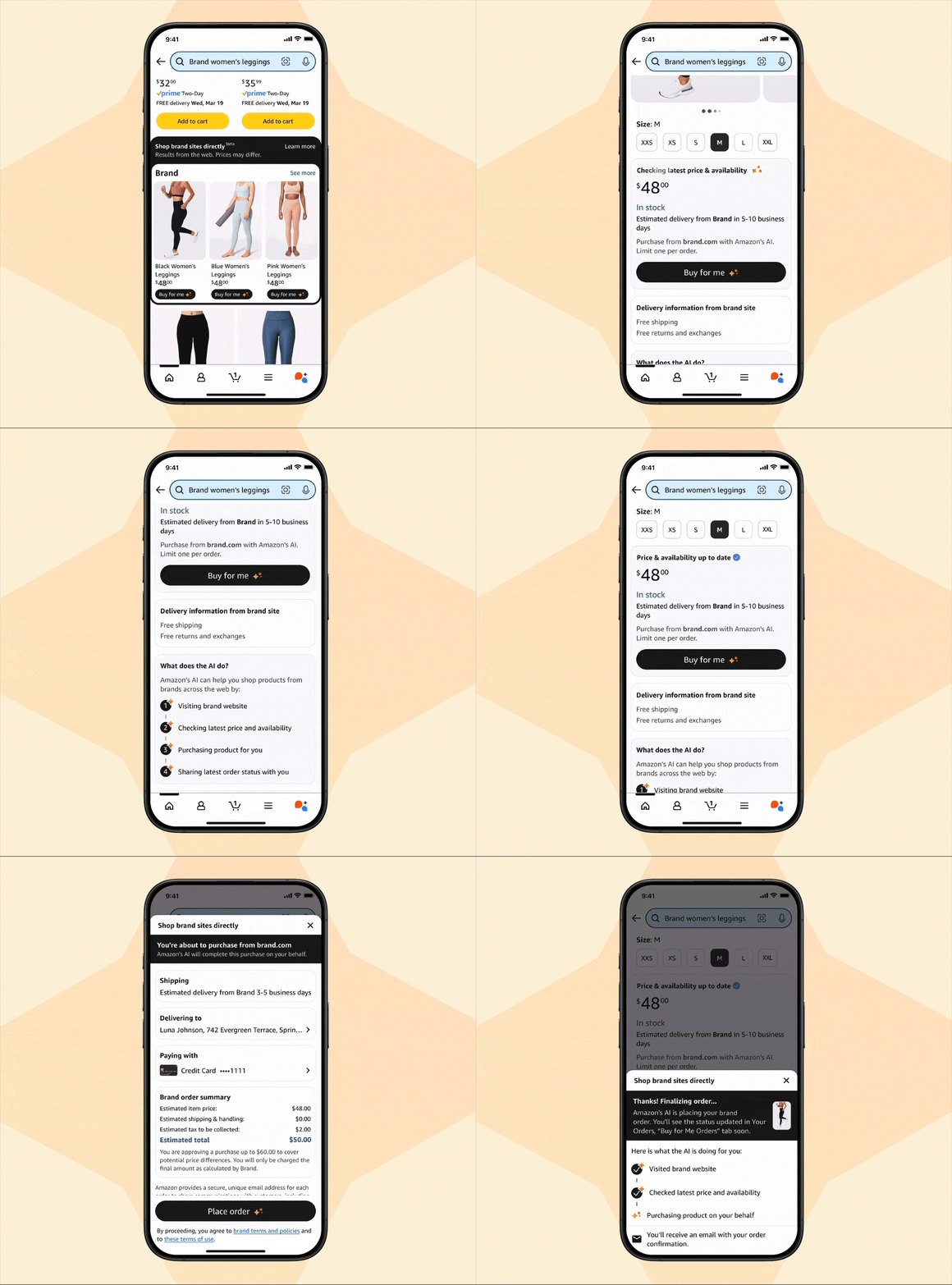
Amazon is taking a different approach with its "Buy for Me" feature. Using agentic AI, Amazon can complete purchases from other brand websites directly within its own app.
This is how it works:
Amazon expands its product catalog without the need for seller onboarding
Amazon buyers stay in the Amazon universe, where they can buy products from external sites
The transaction is done inside Amazon
The Agent completes the purchase off-site
The merchant sees the order and gets paid by Amazon
The strategic bet here is that Amazon wants to become the one-stop shopping destination.
As shopping director Oliver Messenger described, the goal is to help customers find and buy products easily, no matter where they are sold.
The physical store becomes more important
Interestingly, agentic commerce is making physical retail more important again.
When AI can sort through thousands of products in seconds, the need to browse digital catalogs changes.
People still want to see and feel products. When finding the right item becomes easy, the final decision becomes more important. Touching a fabric, sitting in a chair, or experiencing a brand in person cannot be replaced.
This is where the physical store has the possibility to elevate the experience and give people what they will miss out on, in a curated AI experience.
Three strategic shifts every retailer must make now
To adapt, retailers need to rethink their strategy in three key areas.
1. Change the purpose of your website
If your website is just a product catalogue, it will not be enough. AI can already handle search and filtering better than humans.
Your website needs to become a place for inspiration. It should provide context, storytelling, and guidance that an AI agent cannot replicate.
2. Put loyalty and first-party data first
You no longer control what an AI recommends in the same way you control ads today. That makes direct relationships more important than ever.
Strong customer loyalty and rich first-party data are what protect your business. They allow you to personalize, engage, and build long-term value.
3. Make sure you show up in LLMs
Generative search optimization (GEO) is becoming just as important as traditional SEO.
It is not enough to have product data. You need to provide context that AI can understand and use. If AI cannot find or interpret your content, you will not be part of the decision.
From product-led to outcome-led experiences
This shift goes even further.
Today, ecommerce is built around products. Customers are expected to know what they want, search for it, and make a choice.
Agentic commerce changes this. Customers can describe what they want to achieve instead of what they want to buy. The AI then builds the solution.
This moves ecommerce from product led to outcome led experiences.
For example, instead of browsing TVs, a customer might describe their living space and preferences. The experience becomes more personal and more helpful. It is built around the customer’s life, not just your inventory.
This applies in store as well. AI tools can guide customers, answer questions, and support decisions in real time. The digital and physical experience come together around the same goal.
Understand what the customer wants to achieve, then help them get there.
Agentic is really not a new channel, it’s a strategic consideration
Agentic commerce is often discussed as a technical topic. Another channel, another integration, another feature.
This is not a technical question, it’s a strategic decision. a leadership question.
Retailers need to rethink what their experience should look like in the coming years. What is the role of your store when transactions are frictionless. What is the role of your website when a catalogue is not enough. What does loyalty look like when you do not control discovery.
These are strategic questions that need attention at the highest level.
The retailers who succeed will not be the ones who simply adapt. They will be the ones who rethink their entire approach.
The opportunity is there for those who act now.
If you are ready to explore what this means for your business, let's set up an inspirational session on agentic commerce: what is happening right now, how it will shape the future of retail experiences, and what your business needs to do to stay ahead.