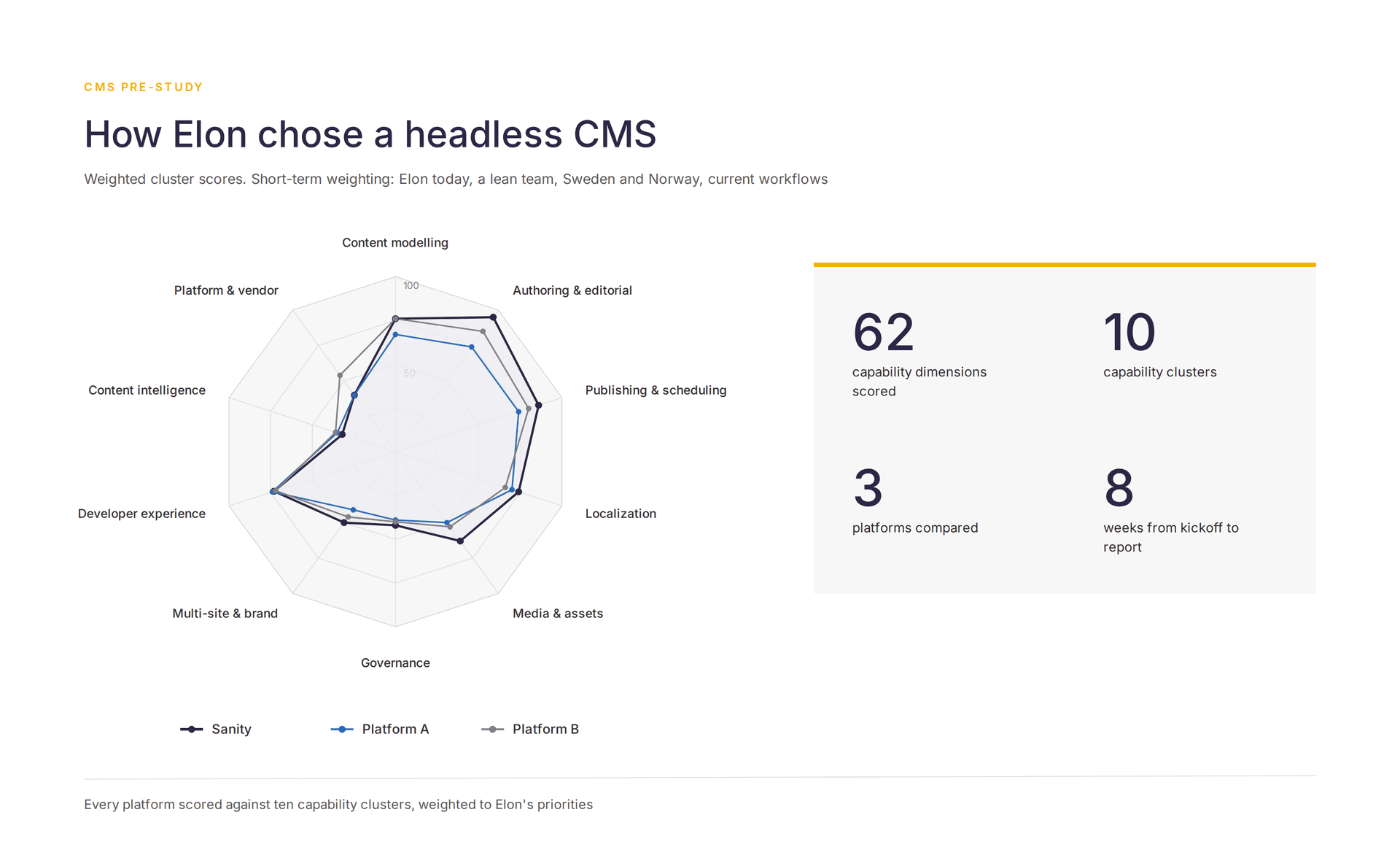
Every platform scored against ten capability clusters, weighted to Elon's priorities.
Our areas of expertise
Our core offerings
Our Insights

Vaimo ran a pre-study that compared three headless CMS platforms against what Elon actually needed, and found a clear winner.
Elon is the Nordic region's largest specialist retail chain for consumer electronics and home appliances, with more than 500 stores across the region. Elon and Euronics are closely connected through a strategic retail partnership and corporate merger, and Elon has worked with Vaimo on ecommerce development for approximately seven years.
Elon managed content with the basic CMS tools that are built into Adobe Commerce. Editorial work was slow and content could not easily be reused between sites and markets. Elon knew they needed a headless CMS. The open question was which one to pick and how to prove it was the right choice.
Vaimo ran an eight-week pre-study, from January to March 2026. Two workshops brought Elon's content editors and IT stakeholders together to set the requirements, then Sanity and two other shortlisted platforms were scored against 62 capability dimensions. Elon got a weighted scorecard, a written recommendation and vendor demos built around their own use cases.
A weighted scorecard
that showed where the three platforms differ and which of those differences mattered to Elon.
Off-the-shelf platform comparisons rank features, but they do not tell you which features matter in your business. Five things about Elon shaped the weighting:
A lean editorial team with growing demands. The team had to publish more, and keep control, without hiring.
A commerce-driven setup. Content has to be connected to product data and commercial workflows, not managed
separately.
Multi-market ambition in the Nordics and beyond. Structured reuse matters, but local markets still need room to adapt what they publish.
Structured, reusable content. Growth requires moving from page-based publishing to modular content.
Governance that is clear but light. Ownership, workflows and visibility, without adding steps that slow editors down.
The CMS inside Elon's Adobe Commerce solution was not built with content editors in mind. Publishing took longer than it should. The system was complex enough that Elon hesitated to bring more people into it, and there was no practical way to automate work or reuse content elsewhere.
Elon's ambition went further than fixing the tooling. Most electronics retailers present products well and publish almost nothing around them. Elon wants to sell with guides and inspiration that help customers pick the right appliance and get the most out of it. Content like that only pays for itself if you build it once and use it in several places. The old setup could not do that.
The pre-study ran in three steps.
Workshop one: objectives and requirements. Content editors and IT stakeholders mapped pain points, business objectives, content types and the key content use cases. Elon's daily reality became the evaluation criteria.
Workshop two: capability evaluation and decision signals. The criteria were grouped and prioritised: authoring experience and collaboration, content modelling and search, publishing and localisation, then governance and access.
Two things came out of the workshops that nobody had put into words beforehand. Media management was a bigger drag than anyone had said out loud:
1. A flat folder structure with no way of seeing where an asset was being used, so editors avoided replacing images rather than risk breaking a page they could not see.
2. Campaign scheduling turned out to be a coordination problem rather than a technical one. Editors could schedule a publish, but without a view of everything going live together, each release meant checking things by hand before anyone felt comfortable pressing go.
Capability scoring and comparison. Vaimo scored Sanity and two other shortlisted platforms against 62 capability dimensions in ten clusters and weighted them by what Elon had said mattered most. The written report set out the recommendation, the reasoning behind it and what the choice would mean for governance, operations and the roadmap.
Vaimo also gathered quotes from all three vendors and supported the tender on price. Each vendor then built a demo around Elon's own requirements, so what Elon saw in the room reflected how they would actually work.
Three of Sanity's AI capabilities are available to Elon's editors at launch, and none of them need custom development.
AI Assist works inside the Studio, so editors can generate, summarise, translate and refine content in the document fields they are already working in. Instructions are set at schema level, which means editorial intent, tone and constraints are defined once per field rather than typed into a prompt every time.
Canvas is a free-form space next to the Studio for drafting and restructuring before anything becomes a published document. It works out of the box, so editors can use it from day one for campaign copy or for reworking text they already have.
AI Agent handles multi-step jobs: drafting a full landing page from a brief, or applying the same change across many documents at once. Basic use cases run on configuration alone. Anything fully autonomous or integration-heavy would need custom development and is not in phase one.
For a lean team publishing more without hiring, this is the part that compounds.

The trade-offs
A recommendation with no downsides is a sales pitch. The report named two:
1. Getting the full editorial experience means slight customisation of Sanity Studio during implementation.
2. Advanced personalization and experimentation rely on integrations or customization rather than native features.
Elon went in knowing both, which is the point. The trade-offs are now part of implementation planning rather than unpleasant surprises.
The two sides wanted different things. IT's priorities were architectural: clean separation between dev, staging and production as well as clear boundaries between CMS and commerce, something maintainable in five years. Marketing wanted speed and independence such as previews they could trust, visibility over what was scheduled, and the ability to publish without a developer in the loop.
Nobody had to argue their corner. Because Elon's real constraint is a lean editorial team facing growing demand, editorial capability outweighed technical release tooling, and that came out of Elon's own requirements rather than a judgement call. Scoring against long-term scenarios as well as current needs meant both sides could see it holding up beyond year one.
A decision Elon can defend, with scored reasoning behind it rather than vendor preference.
A shared set of requirements owned by IT and marketing together.
Three vendor offers sized against real numbers rather than assumptions: user counts, environments, locales, integration scope and data residency.
Three deliverables that now guide implementation: the workshop board, the weighted scorecard and the pre-study report.
A fast start on the build, with Sanity work beginning in June and the first launch set for October.
"The pre-study gave us a clear, structured way to evaluate our options and made the CMS decision feel much more confident and defensible."
Björn Nilsson
System Owner, Ecommerce & Web Shop at Elon
Implementation started in June 2026 and the first launch is planned for October. The same Vaimo team that handles Elon's ecommerce development is doing the Sanity build and is working with the same IT and marketing stakeholders who set the requirements in the pre-study.
Phase one covers the webshop. What comes next is not fixed, and that is the point of the architecture: adding a channel should not mean replatforming. With the content model planned properly, the same source can feed mobile, in-store screens or email, and the same CMS can take on more brands when they come into scope.

You’re ready to find the right headless CMS for your organization. Maybe you’ve already done some homework and sat through demos. Or perhaps you are still figuring out what you need.